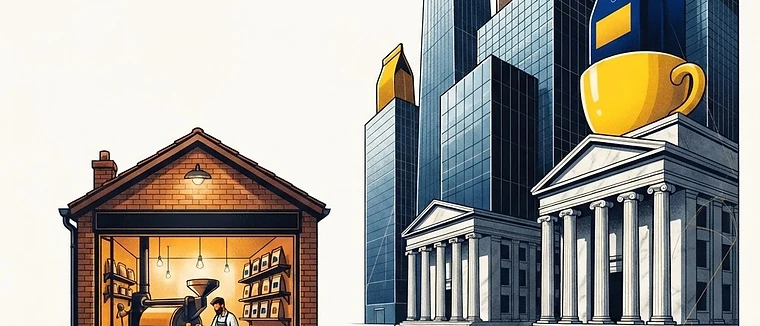
WHO Owns Your Favorite Coffee Brand? The Corporations Behind the Beans
That small-looking roaster on your shelf may belong to Nestlé, JAB, Keurig Dr Pepper, Coca-Cola or Chobani. Here is the verified map of who owns the coffee aisle.
Coffee is one of the most consolidated consumer products on earth. Nestlé is the biggest owner of coffee brands in the world, and the Luxembourg-based JAB Holding Company controls more coffee brand names than any other single player. Between them — plus Keurig Dr Pepper, J.M. Smucker, Kraft Heinz, Coca-Cola, Lavazza, Tchibo and Chobani — a huge share of the coffee aisle is corporate-owned, including brands that look and feel like small independents. Some of your coffee really is independent. Some of it really is not. This story maps every major owner, using company press releases and public filings as the evidence.
The coffee aisle has a secret
Most people shopping for coffee assume the same thing: if the bag has an artisan-looking label, a story about a farm, and a roaster's name on it, a small company made it. Sometimes that is true. Increasingly, it is not.
Over the past fifteen years, a handful of the world's largest food, beverage and investment companies have quietly assembled portfolios of coffee brands — from instant giants to some of the most respected names in American specialty coffee. The deals are all public. They are announced in press releases, described in shareholder filings, and reported in the business press. But almost none of that reaches the retail shelf, where every bag still wants to look like the work of a craftsman.
This is the full ownership map: who owns the most coffee brands, which publicly traded giants own which labels, whether the corporations that own other corporations are in the coffee business (spoiler: yes, deeply), and how you can tell whether the coffee in your cabinet answers to a founder, a family — or a fund. Every claim here comes from company announcements, public filings, or our own verified brand directory. Nothing is rumored. If ownership is uncertain, we say so.
WHO owns the most coffee brands?
By sheer volume of coffee sold, the answer is Nestlé, the Swiss food giant. Nestlé is by many measures the largest coffee company in the world: its coffee sales run into the tens of billions of dollars a year, and it buys a double-digit share of all the coffee traded globally. Its brand list is enormous — Nescafé, the best-selling instant coffee on earth; Nespresso, the capsule empire; Dolce Gusto; Taster's Choice; and, since 2017, the cult specialty roaster Blue Bottle Coffee. Nestlé also holds the licensing rights that put Starbucks-branded coffee on supermarket shelves worldwide.
By number of coffee brand names controlled, the answer is JAB Holding Company — the Luxembourg-based, family-owned investment firm run by the Reimann family. Through its coffee empire, JAB controls or has controlled Jacobs, Douwe Egberts, L'OR, Senseo, Tassimo, Gevalia, Moccona, Pickwick, Peet's Coffee, Stumptown Coffee Roasters, Intelligentsia Coffee, Caribou Coffee, Keurig, Espresso House and more. No single entity has bought more coffee brands in the modern era than JAB.
Behind those two sit the rest of the giants, each with a different strategy. Keurig Dr Pepper (Nasdaq: KDP) owns the single-serve ecosystem that dominates US at-home coffee. J.M. Smucker (NYSE: SJM) owns Folgers and Café Bustelo — the two best-selling packaged coffees in America. Kraft Heinz (Nasdaq: KHC) owns Maxwell House. The Coca-Cola Company (NYSE: KO) owns Costa Coffee, the world's largest coffeehouse chain by store count at the time it was purchased. Italy's Lavazza is a family-owned giant that has been buying brands across Europe. Germany's Tchibo owns Eduscho. Massimo Zanetti Beverage Group owns Hills Bros., Chock full o'Nuts and Pura Vida. And Chobani — yes, the yogurt company — owns La Colombe.
One number puts it in perspective: we track more than 600 US specialty coffee brands in our directory, and our verification pipeline keeps confirming that the share of 'independent' brands is smaller than the marketing suggests. The coffee industry looks like thousands of little companies. Its economics look like an oligopoly.
JAB Holding Company: the invisible hand behind American coffee
If you have heard one name in coffee ownership, it is probably JAB — and the association is real. JAB Holding Company is the private investment vehicle of the Reimann family, heirs to the chemical empire behind some of the world's most familiar consumer products. Starting in 2012, JAB went on the greatest acquisition spree in coffee history, and almost none of the brands it touched advertised the fact.
The run started with Peet's Coffee, the Berkeley, California roaster often credited with launching specialty coffee in America, which JAB and its partners bought in 2012 for roughly a billion dollars. Peet's then became the acquisition vehicle: in 2015 it bought Stumptown Coffee Roasters, the darling of Portland's third-wave scene, and Intelligentsia Coffee, the Chicago roaster that helped define the modern specialty movement. Those two transactions are the moment a large chunk of American 'indie' coffee became corporate coffee.
In the same window JAB took Caribou Coffee private, assembled Jacobs Douwe Egberts (now JDE Peet's, publicly listed in Amsterdam, which owns Jacobs, L'OR, Senseo, Tassimo, Gevalia, Moccona and Pickwick), and in 2015 led the roughly $14 billion buyout of Keurig Green Mountain — the company behind the K-Cup. In 2018 Keurig merged with Dr Pepper Snapple to form Keurig Dr Pepper, a publicly traded beverage giant in which JAB-backed funds remain the largest shareholder. JAB has also held European café chains such as Espresso House, and — outside coffee — owns chains like Pret A Manger and, since 2017, Panera Bread.
The pattern matters as much as the names. JAB rarely operates these brands day to day. It owns them through layered holding structures, keeps the branding exactly as it was, and lets the founders' aesthetics do the selling. A bag of Stumptown looks precisely like it did in 2014. The company behind it does not.
Our readers can see this directly: our answer to what brands JAB owns, and our brand pages for Intelligentsia, Stumptown and Peet's, carry the same ownership disclosures with sources.
Nestlé: the world's biggest coffee company — and yes, it owns specialty coffee brands
People often ask whether the mega-corporations that own other mega-corporations are actually in the coffee business. Nestlé is the cleanest answer: a Swiss-listed company with hundreds of billions in market value, operating in dozens of product categories — and it is arguably the most powerful coffee company on earth.
Nestlé invented Nescafé in 1938 and has dominated instant coffee ever since. It built Nespresso into a machine-and-capsule business that rivals the economics of razor blades. But what made specialty coffee drinkers pay attention is that Nestlé started buying the specialty world itself. In 2017 it acquired a majority stake in Blue Bottle Coffee — the Oakland roaster that had become the emblem of slow, careful, independent coffee — in a deal that valued the company at several hundred million dollars. Later that year it bought Chameleon Cold-Brew. In 2022, it acquired Seattle's Best Coffee from Starbucks.
The Starbucks relationship confuses people, so let's be precise. Nestlé does not own Starbucks. In 2018 Nestlé paid Starbucks about $7.15 billion for the rights to market, sell and distribute Starbucks-branded packaged coffee and tea worldwide — the bags, capsules and ready-to-drink products you find in grocery stores. Starbucks the chain, and the brand itself, remain an independent publicly traded company (Nasdaq: SBUX). But the 'Starbucks' coffee bag on the supermarket shelf is a Nestlé operation.
So the answer to 'do the giant corporations that own other giant corporations own coffee brands?' is an emphatic yes — Nestlé is a conglomerate of conglomerates, and it owns everything from the cheapest instant coffee on the market to one of the most fetishized specialty roasters of the last decade.
The publicly traded giants: Coca-Cola, Smucker, Kraft Heinz, and Keurig Dr Pepper
Beyond Nestlé and JAB, the coffee aisle is carved up by household-name public companies whose coffee portfolios most shoppers have never connected.
The Coca-Cola Company — a soda company — bought Costa Coffee from Whitbread in a deal completed in early 2019 for about $4.9 billion, instantly making it a global coffeehouse operator. Coca-Cola also owns Georgia Coffee, a coffee giant in Japan that most Americans have never heard of. Coke's entry told the whole market that coffee was too valuable to leave to coffee companies.
J.M. Smucker is the quiet king of American grocery-store coffee. Procter & Gamble handed Folgers to Smucker in 2008, and Smucker bought Café Bustelo in 2011. Smucker also produces Dunkin'-branded at-home coffee under license, and its Millstone brand rounds out the roster. If your parents drink coffee at home in the US, there is a good chance Smucker owns it.
Kraft Heinz owns Maxwell House, the brand that defined American coffee for most of the twentieth century, along with Yuban. And Kraft Heinz itself is the perfect example of ownership layered on ownership: the packaged-food giant is controlled substantially by Berkshire Hathaway — Warren Buffett's conglomerate — and the Brazilian investment firm 3G Capital. So the chain for a can of Maxwell House reads: Berkshire Hathaway and 3G Capital → Kraft Heinz → Maxwell House.
Keurig Dr Pepper (Nasdaq: KDP) is the most important coffee company most consumers can't picture. It owns the Keurig brewing system and Green Mountain Coffee Roasters, and its merger history — Keurig Green Mountain (itself a JAB buyout) combining with Dr Pepper Snapple in 2018 — makes it the textbook case of a publicly traded coffee company whose real owner is a private holding company above it.
The specialty brands that stopped being independent
This is where the story gets personal for specialty coffee drinkers, because the consolidation did not stop with the big legacy brands. It reached the roasters whose bags you proudly show off.
The most famous casualties: Stumptown and Intelligentsia, sold to Peet's (JAB) in 2015; Blue Bottle, majority-owned by Nestlé since 2017; Caribou, under JAB since 2012; and La Colombe, the Philadelphia roaster that became ubiquitous on cafe menus, which Chobani — the yogurt company — bought in late 2023. In each case the brand kept its name, its aesthetic, and its farm stories. What changed is who the money flows to.
Our own brand directory, which verifies ownership with public sources, shows the quieter versions of the same pattern across the US: roasters grouped under FairWave Specialty Coffee Collective, including Spyhouse, Ceremony Coffee Roasters, Anodyne, Black & White and Fiddleheads; Victrola Coffee Roasters under Vibe Coffee Group; Batdorf & Bronson under Dillanos Coffee Roasters; Cameron's Specialty Coffee under Colombia's Grupo Nutresa; Royal Kona and Lion Coffee both under Hawaii Coffee Company; Bird Rock Coffee Roasters under PT's Coffee Roasting Co.
None of this means these coffees are bad. It means the 'independent roaster' story on the bag is sometimes written by a marketing department reporting to a portfolio manager. Ownership does not tell you how a coffee tastes — but it does tell you whose incentives shape how the farmers were paid, how transparent the sourcing is, and what happens to the brand when the portfolio changes.
Brands that really are independent
The good news: the truly independent specialty scene is still real, and still large. Roasters like Counter Culture Coffee in North Carolina, Onyx Coffee Lab in Arkansas, PT's Coffee in Kansas, Philz Coffee in California, Verve Coffee Roasters and Wandering Bear in the cold-brew aisle — along with hundreds of smaller regional roasters in our directory — remain founder- or family-owned, with no parent company disclosed behind them.
Independence, though, is a spectrum, not a badge. Some 'independent' brands are backed by private equity that doesn't show up on the label. Some are owned by restaurateurs, churches, tea companies, or other coffee companies — our verification pipeline routinely finds parents like Turning Point Restaurants, Adagio Teas, or church foundations behind small roaster brands. 'Independent' means no large corporate parent — it does not mean no owner beyond the founder.
That is why we publish ownership_scale and ownership_note fields — LARGE CORPORATION, MID-SIZE GROUP, INDEPENDENT or UNKNOWN — on every brand page in our US specialty coffee directory, with the sourcing disclosed. If we could not verify a brand's ownership, the page says so rather than guessing.
Do corporations that own other corporations own coffee brands? The holding-company chain, explained
The question sounds abstract until you trace one bag up its ownership tree. Modern coffee ownership is not usually a straight line from brand to company. It is a chain of holdings, and the top link is often invisible from the shelf.
Take Maxwell House: Berkshire Hathaway (Warren Buffett's conglomerate) and 3G Capital together control Kraft Heinz, and Kraft Heinz owns Maxwell House. Two corporate layers above the brand. Take Keurig: JAB-backed funds are the largest shareholder of Keurig Dr Pepper, a public company — so a shareholder of KDP drinks from a machine whose parent company is effectively steered by a private family office in Luxembourg. Take the Starbucks grocery bag: the brand belongs to Starbucks (public), but the packaged product is sold by Nestlé (public, and itself a conglomerate of dozens of acquired companies). Take Pret A Manger or Panera: both are owned by the same JAB that owns Peet's, Stumptown and Intelligentsia — which means the same family office is embedded in both your lunch and your morning pour-over.
Nestlé, meanwhile, is the clearest case of a corporation-of-corporations in coffee: a Swiss giant that owns not just its own legacy coffee brands but acquired specialty roasters (Blue Bottle), a cold-brew brand (Chameleon), a legacy Seattle brand (Seattle's Best), and the global licensing rights to Starbucks packaged coffee. When people ask whether the 'big companies that own big companies' are in coffee, the honest answer is that they are among coffee's biggest players — you just never see their names on a bag.
One more wrinkle worth knowing: publicly traded coffee companies are themselves owned by shareholders — index funds, pension funds, and yes, other corporations. Coca-Cola owns Costa; Coca-Cola's largest shareholders include the giant asset managers; and Keurig Dr Pepper appears inside funds that also hold Nestlé and Starbucks. At the very top, coffee ownership is a web, not a ladder. What matters practically is the layer just above the brand: is there a giant there or not?
How to tell whether your coffee is independent or corporate
You cannot tell from the bag. That is the first and most important rule. Corporate owners preserve the independent look deliberately — it is an asset they paid for. Here is how to actually check.
Start with our directory: every page in our US specialty coffee brand guide lists the parent company (when one exists), the ownership scale, and a sourcing note, with links to the evidence. If we have verified a brand as independent, it says so. If it answers to JAB, Nestlé, Chobani, Keurig Dr Pepper or a regional group, it says that too.
Outside our site, the trail is public if you know where to look. Search the brand's name plus 'acquisition' or 'acquired by' — every major deal in this story was announced in a press release. For public companies, the Securities and Exchange Commission's EDGAR database holds annual reports (10-Ks) that list owned brands; Smucker's, Kraft Heinz's and KDP's filings are the coffee aisle in bureaucratic prose. Many roasters disclose their corporate structure in a footnote on their own site or in their founders' press coverage.
And be alert to euphemisms. 'Backed by', 'partnered with', 'a member of' and 'part of the X family of brands' almost always mean 'owned by'. A roaster that says it is 'independent in spirit' is telling you something about its actual ownership.
Finally, keep perspective. A corporate owner is not automatically villainous, and an independent owner is not automatically virtuous. What ownership actually changes is accountability: an independent roaster that mistreats farmers answers to its own conscience; a brand inside a portfolio answers to a portfolio strategy. Transparency is the tell either way — which is why every brand page here links its sourcing claims to named sources.
FAQ: Who owns the most coffee brands in the world?
Nestlé owns the most coffee volume — Nescafé, Nespresso, Dolce Gusto, Blue Bottle, Seattle's Best and the Starbucks packaged-coffee license. JAB Holding Company controls the most coffee brand names, through JDE Peet's, Peet's Coffee, Stumptown, Intelligentsia, Caribou and Keurig Dr Pepper.
FAQ: Does Nestlé own specialty coffee brands?
Yes. Nestlé took a majority stake in Blue Bottle Coffee in 2017, bought Chameleon Cold-Brew the same year, and acquired Seattle's Best Coffee from Starbucks in 2022. It also paid about $7.15 billion in 2018 for the right to sell Starbucks-branded packaged coffee worldwide — though it does not own the Starbucks chain.
FAQ: Is Stumptown still independent?
No. Stumptown Coffee Roasters was bought by Peet's Coffee in 2015, and Peet's has been owned by JAB Holding Company since 2012. Intelligentsia joined the same family the same year. The branding is unchanged; the ownership is not.
FAQ: WHO owns La Colombe?
Chobani, the yogurt company, acquired La Colombe in late 2023. It is one of the most surprising recent deals in specialty coffee — a yogurt maker buying a roaster that helped define the modern American coffee bar.
FAQ: Is Keurig Dr Pepper owned by JAB?
Keurig Dr Pepper is a publicly traded company (Nasdaq: KDP), but JAB-backed funds remain its largest shareholder. Keurig Green Mountain itself was bought by a JAB-led group in 2015 for roughly $14 billion before the 2018 merger with Dr Pepper Snapple.
FAQ: WHO owns Folgers, Café Bustelo and Maxwell House?
Folgers and Café Bustelo are owned by J.M. Smucker — Folgers came from Procter & Gamble in 2008, Café Bustelo was acquired in 2011. Maxwell House belongs to Kraft Heinz, which is itself substantially controlled by Berkshire Hathaway and 3G Capital.
FAQ: Does Coca-Cola own a coffee brand?
Yes. Coca-Cola bought Costa Coffee, then the world's largest coffeehouse chain by store count, for about $4.9 billion in a deal completed in early 2019. It also owns Georgia Coffee, a major coffee brand in Japan.
FAQ: Does JAB own Starbucks?
No. Starbucks is an independent publicly traded company. JAB owns Peet's, Caribou, and stakes in Keurig Dr Pepper and JDE Peet's. Nestlé — not JAB — holds the Starbucks packaged-coffee license. The three giants compete.
FAQ: How do I check WHO owns my coffee brand?
Search the brand name with 'acquired by' or 'acquisition' for the original press release, check the parent company's SEC filings if it is public, and check our specialty coffee brand directory — every brand page discloses its parent company, ownership scale, and sourcing transparency with links to evidence.
The bottom line: the beans have been spilled
Coffee is the world's favorite way to feel like an individual — and one of the world's most consolidated industries. Nestlé owns the volume. JAB owns the names. Coca-Cola, Smucker, Kraft Heinz, Keurig Dr Pepper, Lavazza, Tchibo and Chobani own the rest of the shelf. Some of what looks like an independent roaster is one; much of it is not.
None of this means you should stop buying coffee from brands with corporate parents — several of them genuinely source well and pay farmers properly, and we say so on the pages where the evidence supports it. It means you deserve to know who you are actually buying from. Ownership changes incentives: how farmers are paid, how much sourcing is disclosed, and how quickly a beloved brand gets pushed toward scale at the expense of craft.
That is why we verify ownership brand by brand — with sources, disclosed openly — and why this directory keeps growing. Spilled beans, as promised. Check your favorite brand's page below, and if we got a detail wrong, our correction form is one click away. We would rather be corrected than vague.
- · Nestlé — press release, acquisition of Blue Bottle Coffee: https://www.nestle.com/media/pressreleases/allpressreleases/nestle-blue-bottle-coffee
- · Nestlé — press release, Nestlé and Starbucks global coffee alliance: https://www.nestle.com/media/pressreleases/allpressreleases/nestle-and-starbucks-create-global-coffee-alliance
- · The Coca-Cola Company — Costa acquisition announcement: https://www.coca-colacompany.com/media-center
- · JAB Holding Company — portfolio overview: https://www.jabholding.com/
- · Keurig Dr Pepper — investor relations and SEC filings: https://investor.keurigdrpepper.com/
- · J.M. Smucker — investor relations and brand portfolio: https://www.jmsmucker.com/
- · Kraft Heinz — annual report and brand portfolio: https://ir.kraftheinz.com/
- · JDE Peet's — company overview: https://www.jdepeets.com/
- · Chobani — La Colombe acquisition announcement: https://www.chobani.com/
- · Lavazza Group — company history and acquisitions: https://www.lavazza.com/
- · Massimo Zanetti Beverage Group — brand portfolio: https://www.mzb-worldwide.com/
- · US SEC EDGAR — 10-K filings listing owned brands: https://www.sec.gov/edgar/search/
- · WhoMakesTheBestCoffee — US specialty coffee brand directory with verified ownership disclosures: https://coffeenearme.base44.app/specialty-coffee-brands