BEFORE IT WAS A DRINK, IT WAS A PLANT.
Coffee comes from fruit-bearing plants in the genus Coffea. Arabica has roots in eastern Africa, while canephora has a different African range. The beans we roast are seeds inside cherries, shaped by biology, farm care, processing and roasting.
Is a coffee bean really a bean?
No. It is a seed inside a fruit commonly called a coffee cherry. Most cherries contain two seeds, with endosperm and a small embryo. The papery parchment surrounds the seed before harvest; it does not form during drying. Learn more from the botanical reference.
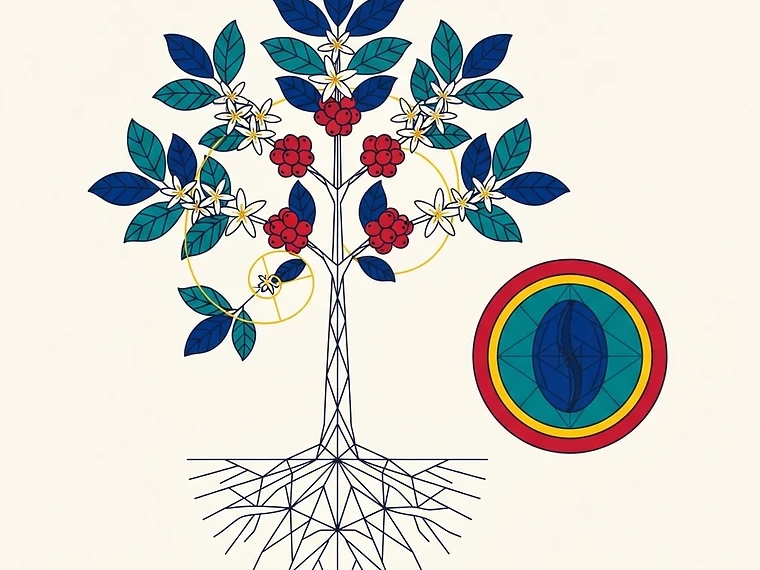
From root to seed.
Roots anchor the plant and absorb water and nutrients. Soil health can affect plant growth, but volcanic soil does not by itself establish cup quality.
The stem supports branches and conducts water and nutrients. Pruning and plant height vary by species, farm, density and harvest method; there is no universal coffee-tree shape.
The framework that carries leaves, flowers and fruit. Producers manage branch renewal so each year's cherries grow on healthy, young wood.
Leaves capture light for photosynthesis. Healthy foliage helps the plant grow and fill fruit, but leaf area alone cannot guarantee sweet cherries.
Fragrant flowers often appear after changes in rainfall. Not every flower sets fruit, and pollination biology differs across coffee species.
The fruit that carries the seeds. A cherry takes months to ripen from green through yellow and pink to deep red — or yellow and purple, depending on the variety.
The fruit's outer skin is removed early in many washed processes and remains around the fruit during natural drying. Fermentation and drying outcomes depend on the whole fruit and handling, not skin sugars alone.
The fleshy fruit tissue contains water, sugars and pectin. Pulping removes much of it in washed processing; whole-fruit drying retains it in natural processing. Sensory effects depend on handling, microbes and drying conditions.
A sticky, pectin-rich part of the fruit's mesocarp lying against the parchment, not directly against the seed. Producers remove it by fermentation, mechanical demucilaging or combinations of techniques.
The papery endocarp develops inside the cherry before harvest, not only during drying. Once dried, it surrounds and protects the seed until hulling.
A paper-thin skin clinging to the seed even after hulling. Roasting removes most of it — it becomes the chaff in every roaster.
The coffee bean is a seed, mostly endosperm with a small embryo. Most cherries hold two seeds with facing flat sides; some form one round peaberry.
Open the coffee cherry.
The colored rings are a simplified educational diagram, not a botanical cross-section to scale. Use the buttons to explore each layer with a keyboard or touchscreen.
The thin, colored outer skin. Bright red when ripe in most varieties. It protects the fruit and, in natural processing, stays around the seed through drying — its sugars feeding the fermentation.
The dried seed is roasted, including its endosperm and small embryo. Fruit tissues and parchment are normally removed before roasting, while much of the silverskin separates as chaff during roasting.
Coffee flowers carry two ovules, and most cherries fertilize both. The two seeds press together as they grow — which is why every normal bean has a flat face.
A peaberry forms when only one seed develops instead of the usual two. Its rounded shape may call for different sorting or roasting, but it is not inherently higher quality.
Mucilage is a sugar-containing layer outside parchment. Microbial activity during some processing methods can change its composition and influence the final coffee, but processing outcomes vary.
Parchment is the protective endocarp that develops in the growing fruit. After drying, hulling removes it. Parchment coffee and hulled green coffee are different stages.
The hulled, dried seed — raw, dense and stable enough to travel the world. Green coffee keeps for months but has almost no coffee aroma. Roasting creates that.
From seed to your cup.
Every stage below answers the same four questions: What is happening? How long does it take? Who is involved? And why does it matter to flavor?
Botanical sources
Reviewed October 2026. Timelines vary by species, climate and nursery practices. This diagram does not validate a specific coffee lot.
- TechnoServe — Wet Mill Processing Guide (2022) — Fruit layers, pulp/mucilage handling, parchment coffee and wet-milling quality controls.
- FAO — Coffee Processing: Introduction — Pulping, mucilage removal and the role of drying in washed coffee.
- Specialty Coffee Association — The Fermentation Effect — Why fermentation and demucilaging outcomes depend on process variables.
- Coffee Seed and Seedling Quality Research (2011) — Viability and drying/storage constraints for coffee seed intended for propagation.
- PROSEA — Coffea botany — Coffee fruit anatomy, flowering, germination and species-specific timelines.
- World Coffee Research — Nursery Management — Coffee nursery and seed management practices.
- Specialty Coffee Association — Cherry to Green Coffee — Coffee fruit processing, drying, milling and roast loss.