THE HISTORY
OF COFFEE
Arabica originated in Ethiopia’s highland forests and was cultivated in Yemen. Coffeehouses, colonial trade, brewing inventions and the people who grew coffee carried the story forward. No historical record establishes one person or year as the discovery of coffee.
Where did coffee come from?
Coffee began as an African plant. Arabica’s history involves Ethiopian forests and centuries of Yemeni cultivation. Later, the drink spread through Ottoman coffeehouses and European and colonial trade. The timeline labels legends and approximate dates instead of presenting them as documented facts. Coffee’s expansion also relied on land dispossession, enslavement and other exploitation.
Explore the timeline
22 sourced events. Select an era to filter; choose All eras to restore the full timeline.
- Prehistory · ORIGINS
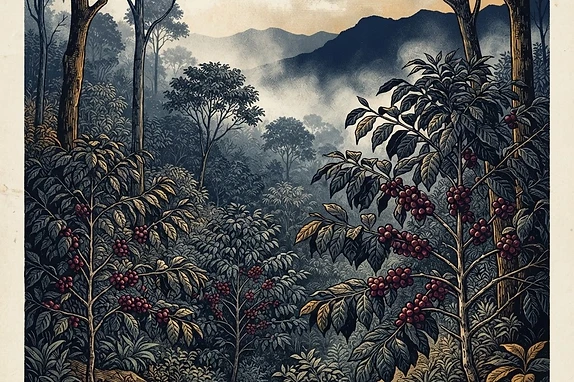
Original editorial illustration, not a documentary photograph Arabica develops in Ethiopia's highland forests
Arabica is a naturally occurring coffee species with deep evolutionary roots in Ethiopia. Its botanical origin cannot be assigned to a ninth-century person or date.
Botanical history
Explore coffee genetics - Undated legend · ORIGINS
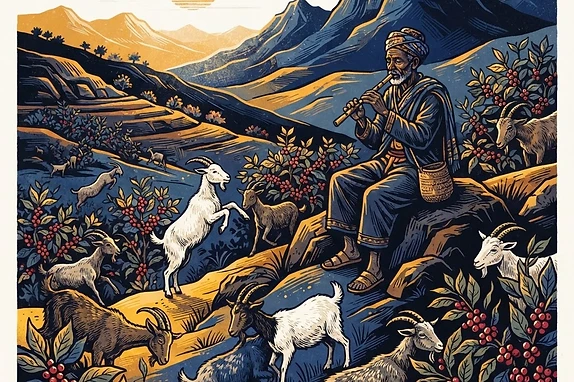
Original editorial illustration, not a documentary photograph Kaldi and the dancing goats
The Ethiopian goatherd story is beloved folklore, not historical documentation establishing when anyone first brewed coffee. Other origin legends also circulate.
Legend, not verified fact
Who discovered coffee? - By the 15th–16th centuries · ORIGINS
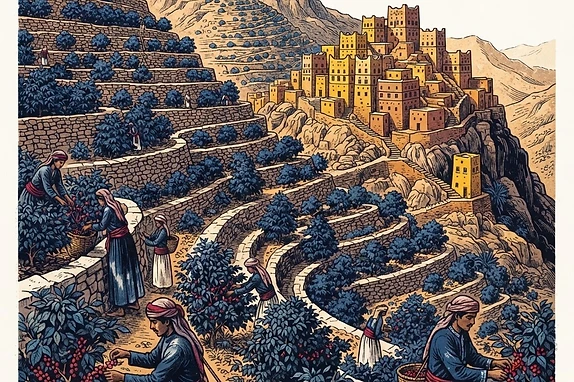
Original editorial illustration, not a documentary photograph Coffee cultivation takes root in Yemen
Yemeni growers domesticated and selected arabica under markedly different growing conditions from Ethiopia's moist forests. Cultivation there is documented over more than five centuries.
Historical evidence
Explore coffee origins - 16th–17th centuries · THE WORLD DRINKS
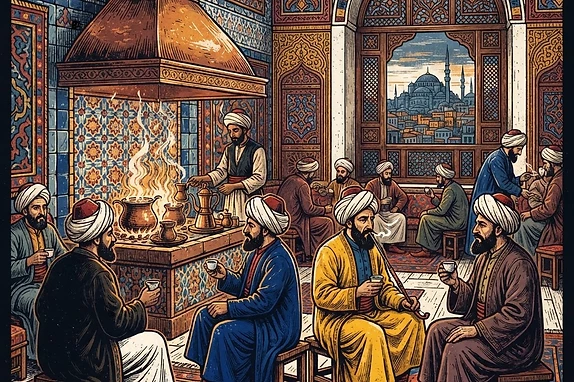
Original editorial illustration, not a documentary photograph Coffee becomes part of Ottoman city life
Coffeehouses became important public spaces in the Ottoman world before the drink spread into Western European café culture; exact claims of a single 'first' coffeehouse vary by account.
Approximate period
- 1651 · THE WORLD DRINKS
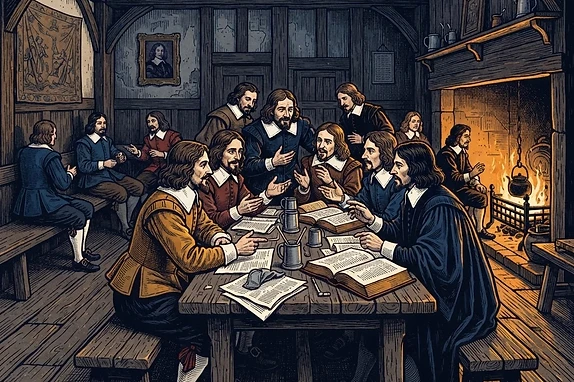
Original editorial illustration, not a documentary photograph An early English coffeehouse opens in Oxford
The Ashmolean Museum dates England's first coffeehouse to Oxford in 1651. Early coffeehouses hosted discussion, scholarship and sometimes controversy.
Documented museum account
- 1652 · THE WORLD DRINKS
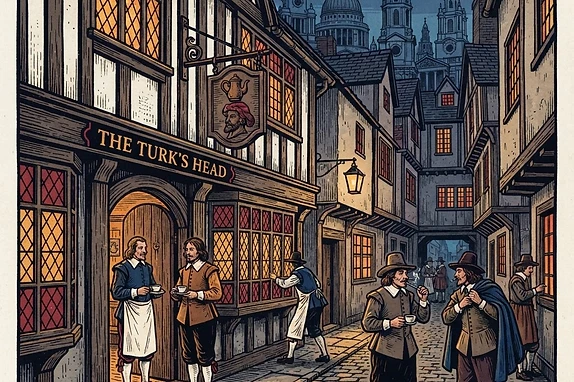
Original editorial illustration, not a documentary photograph Pasqua Rosée opens a London coffeehouse
Historic England identifies Rosée's establishment in St Michael's Alley as London's first coffeehouse. London was not the site of England's first by all accounts.
Historical research
- 17th–19th centuries · COLONIAL EXPANSION
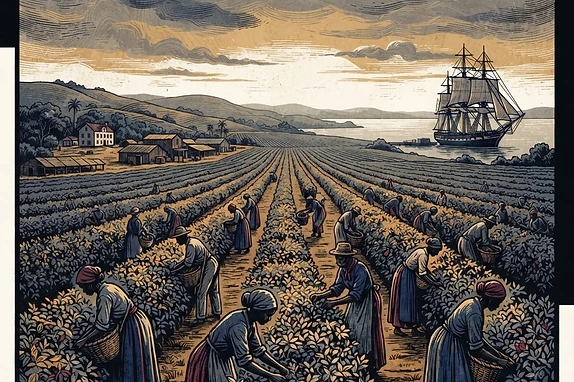
Original editorial illustration, not a documentary photograph Expansion brings exploitation as well as new markets
European colonial coffee production became intertwined with slavery, coerced labor, land seizure and trade in plantation-grown coffee and sugar. These histories belong alongside stories about cafés and innovation.
Historical research
- Around 1734 · THE WORLD DRINKS

Original editorial illustration, not a documentary photograph Bach's Coffee Cantata satirizes coffee enthusiasm
Bach's comic cantata BWV 211 pokes fun at a household argument about coffee. Its composition is generally placed around 1734, not an exact day in 1732.
Approximate date
- 1884 · MODERN COFFEE
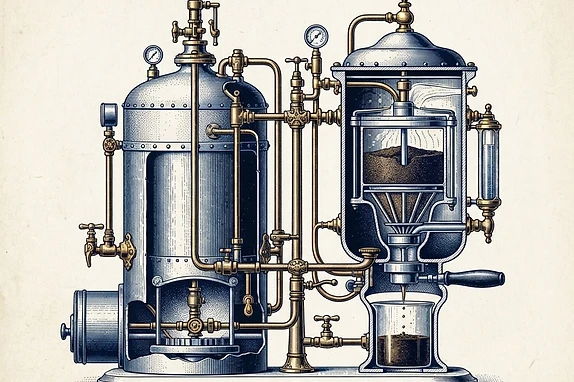
Original editorial illustration, not a documentary photograph An early steam-driven espresso-machine patent
Angelo Moriondo patented a coffee-brewing machine using steam and water. His apparatus brewed in bulk and differed greatly from today's single-shot espresso machines.
Documented patent history
- 1901–1906 · MODERN COFFEE
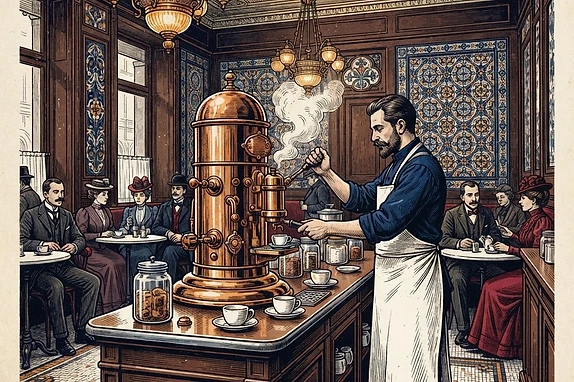
Original editorial illustration, not a documentary photograph Bezzera and Pavoni make espresso a café method
Luigi Bezzera's refinements enabled individually brewed coffee, and Desiderio Pavoni commercialized the machines. Their espresso appeared at the 1906 Milan fair.
Documented equipment history
- 1908 · MODERN COFFEE
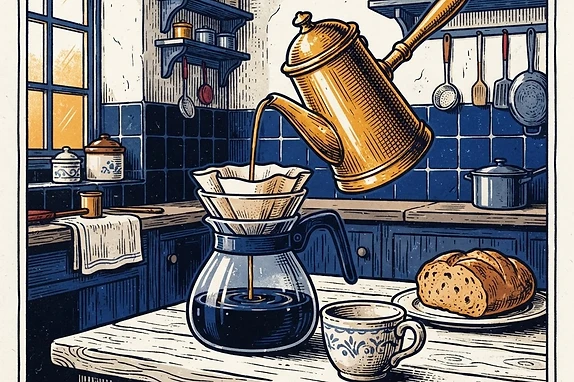
Original editorial illustration, not a documentary photograph Melitta Bentz introduces a paper coffee filter
Bentz's improvised brass cup and blotting paper gave rise to the paper coffee filter and a new approach to cleaner brewed coffee.
Manufacturer history
Explore brewing methods - 1938 · MODERN COFFEE
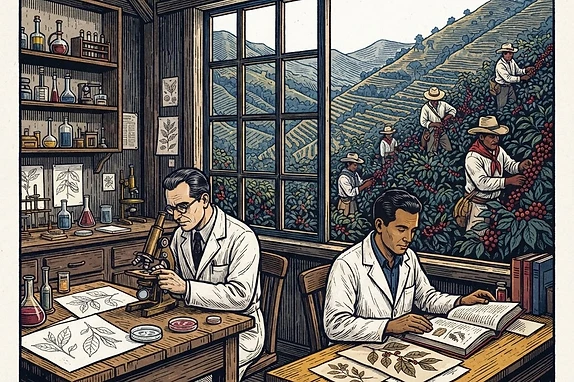
Original editorial illustration, not a documentary photograph Colombia establishes Cenicafé
The Colombian coffee federation's research center begins long-term research for growers. Claims about any particular resistant cultivar need their own lineage and release evidence.
Institutional history
Explore breeding science - Post–World War II · MODERN COFFEE

Original editorial illustration, not a documentary photograph High-pressure lever machines reshape espresso
Achille Gaggia's postwar lever machines made high-pressure espresso and its characteristic crema widely recognizable. Modern espresso did not arrive fully formed in 1884.
Equipment history
- 1974 · THE SPECIALTY ERA
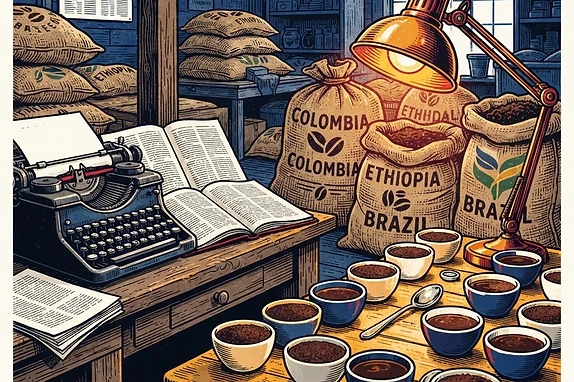
Original editorial illustration, not a documentary photograph Erna Knutsen names 'specialty coffee'
Knutsen used the term in Tea & Coffee Trade Journal to distinguish coffees by quality and provenance, before specialty coffee became a formalized industry category.
Documented publication
Learn specialty-coffee language - 1982 · THE SPECIALTY ERA
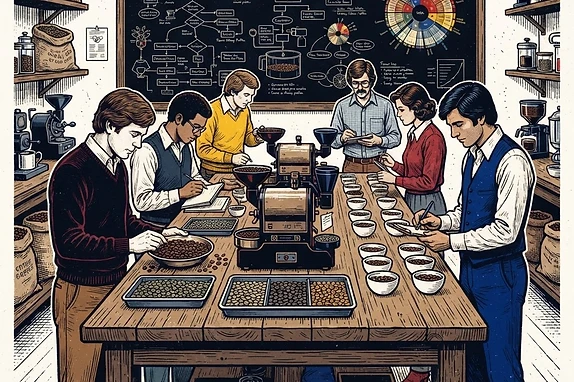
Original editorial illustration, not a documentary photograph The Specialty Coffee Association of America forms
Coffee professionals establish a trade association focused on shared quality standards and education. The present-day unified SCA came later.
Association history
- 1999 · THE SPECIALTY ERA
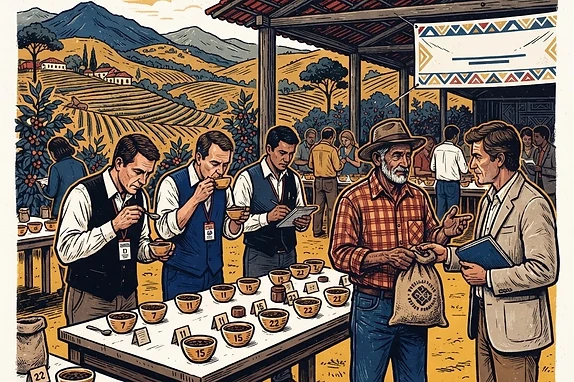
Original editorial illustration, not a documentary photograph Cup of Excellence launches in Brazil
The competition-and-auction program starts in Brazil, connecting identified producers' coffees with international buyers and visible auction results.
Organizer's record
- 2000 · THE SPECIALTY ERA

Original editorial illustration, not a documentary photograph The first World Barista Championship
The championship begins in Monte Carlo. Its later international growth reflects coffee preparation's emergence as a recognized competitive craft.
Organizer's record
- 2004 · THE SPECIALTY ERA
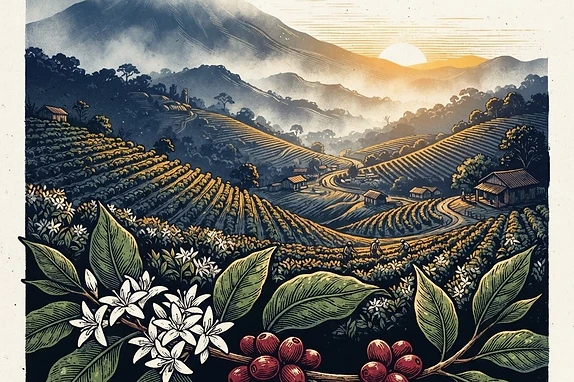
Original editorial illustration, not a documentary photograph Hacienda La Esmeralda's Geisha wins Best of Panama
The Peterson family's separated Geisha lot wins in 2004, helping reshape demand for traceable, distinctive high-value specialty coffees.
Producer's account
Understand Gesha - 2012–2013 · EXPERIMENTAL & FUTURE

Original editorial illustration, not a documentary photograph A devastating Central American coffee rust crisis
Severe rust epidemics hit Central America. The impacts were not uniform, and resistance breeding does not make any variety permanently invulnerable.
Plant pathology research
Climate and resilience - 2017 · THE SPECIALTY ERA
Original editorial illustration, not a documentary photograph Two associations unite as the Specialty Coffee Association
The American and European specialty-coffee associations merge. The change brings previously separate industry organizations together.
Association history
- November 2024 · EXPERIMENTAL & FUTURE
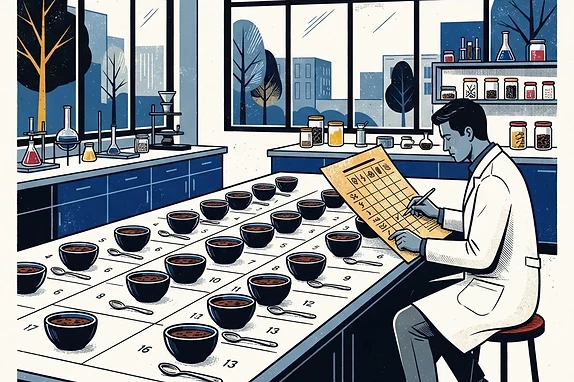
Original editorial illustration, not a documentary photograph New Coffee Value Assessment standards
The SCA publishes standards for sample preparation, descriptive assessment and affective assessment. Coffee quality is not reduced to a universal taste guarantee.
Published standard
- Ongoing research · EXPERIMENTAL & FUTURE
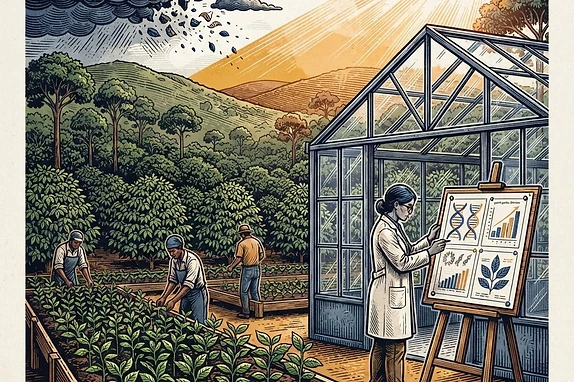
Original editorial illustration, not a documentary photograph Breeding and farm adaptation continue
Research teams and farmers work on coffee genetic diversity and agronomic adaptation. No single proposed solution guarantees future yields, prices or livelihoods.
Ongoing, not a dated milestone
Future of coffee


Research sources and their limits
Dates and claims are attached to documented research, organizers, museums or producers. A source supports the named claim, not every detail of an entire era. This selection is not an exhaustive history of everyone who grew, processed, transported or enjoyed coffee.
- World Coffee Research — Yemeni coffee and the domestication of arabica
Ethiopian forest origins and centuries of cultivation and selection in Yemen.
- Smithsonian Magazine — Coffee, early stories and the American Civil War
Multiple competing discovery legends; folklore is not a documented discovery date.
- University of Oxford, Ashmolean Museum — From Istanbul to Oxford
Ottoman coffee culture and an English coffeehouse in Oxford in 1651.
- Historic England — Transatlantic slave economy and the built environment
Pasqua Rosée's London coffeehouse in 1652 and coffee/sugar in Atlantic plantation economies.
- Netherlands Bach Society — Coffee Cantata BWV 211
Bach's Coffee Cantata is usually dated around 1734.
- Smithsonian Magazine — The long history of the espresso machine
Moriondo's 1884 patent, Bezzera and Pavoni's early-1900s advances, postwar high-pressure espresso.
- Melitta — The Melitta Story
Melitta Bentz's 1908 paper-filter invention.
- Cenicafé — About the Colombian coffee research center
Foundation of Cenicafé in 1938.
- Specialty Coffee Association — Celebrating Erna Knutsen
Use of the term specialty coffee in 1974.
- Specialty Coffee Association — About and history
The 2017 merger of American and European specialty-coffee associations.
- Specialty Coffee Association — Earlier association history
1982 foundation of the Specialty Coffee Association of America.
- Cup of Excellence — Official competition history
Cup of Excellence started in Brazil in 1999.
- World Coffee Championships — 25th anniversary
The World Barista Championship began in Monte Carlo in 2000.
- Hacienda La Esmeralda — Our Story
The Peterson family's Geisha won the 2004 Best of Panama competition.
- APS — Coffee rust epidemics in Central America, 2012–2013
Timing and extent of the destructive 2012–2013 Central American outbreaks.
- Specialty Coffee Association — Coffee Value Assessment standards
Three CVA standards published in November 2024.
- World Coffee Research — Research and coffee futures
Ongoing variety improvement and climate-resilience research; not a dated prediction.
Sources reviewed October 2026. Our research and corrections policy.