WHO GETS THE MONEY?
A $25 bag tells you the retail price, not what a farmer earned. We explain the different prices in coffee trading, show what you can calculate when real transaction data exists, and flag what cannot be inferred.
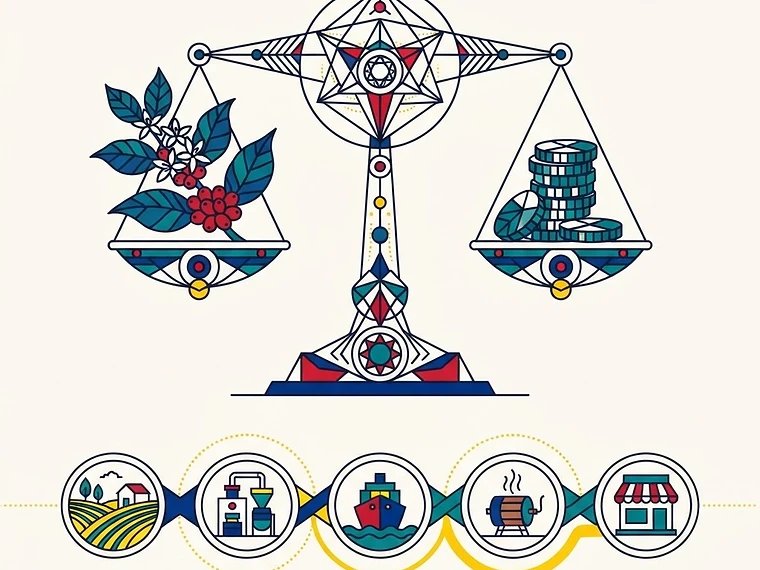
Who gets the money from a bag of coffee?
The grower, workers and multiple service providers can all receive payments, but the amount depends on the actual contracts and supply chain. A roaster’s FOB purchase price is not the farmer’s take-home pay. No single percentage breakdown applies to every bag, and retail revenue does not reveal profit.
What does an FOB price actually tell us?
A bag price does not reveal who earned what. If you have a disclosed export-port (FOB) price, this tool estimates its green-coffee equivalent for a roasted bag. It cannot estimate producer income, profitability or a representative industry split.
What the shopper pays.
Enter the net weight, excluding packaging.
A what-if input from 0 to 30%, not a verified roast measurement.
Optional. Enter a disclosed price or an explicitly hypothetical amount; leave blank if unknown.
Enter a positive FOB price to calculate a scenario. If it is unknown, leave it empty: we will not invent an amount. Other inputs must be positive, with roast loss between 0 and 30%.
Calculation: green pounds = (bag grams ÷ 453.59237) ÷ (1 − assumed roast loss ÷ 100); FOB-equivalent = green pounds × FOB USD per green pound. Cherry, parchment, FOB green and roasted retail prices must not be compared without consistent units and processing stages.
How the Specialty Coffee Transaction Guide defines FOB →What does your coffee cost per brew?
Enter the bag price, bag weight and grounds used for one brew. Use one currency throughout. A brew may serve more than one cup.
2.00 per brew in your entered currency.
12 complete brews, with 10 g remaining. Formula: bag price × dose ÷ bag weight.
Illustrative ingredient cost only. Shipping, tax, wasted grounds, equipment, filters, water, energy and milk are excluded. This calculation does not measure taste or producer payment.
Words you'll meet on any price sheet.
The ICE Coffee C futures benchmark for arabica green coffee, quoted in US cents per pound. It is not a farmgate price, and not all specialty coffees are priced against it.
An agreed adjustment, positive or negative, to a reference market price. Contracts can use different pricing bases; a differential alone does not establish a producer payment.
The price paid to a producer at or near the farm, stated with its currency, date, unit and product form (cherry, parchment or green-equivalent). It is revenue per unit, not net farm profit.
Payment per unit weight of fresh coffee cherries. Do not compare it dollar-for-dollar with parchment or green-coffee prices: moisture and processing yields differ.
Payment for coffee still enclosed in parchment, generally after fruit removal and drying. It uses a different physical product and conversion yield from fresh cherry.
Free on Board: a sale-price basis for coffee placed aboard a vessel at the named export port. It commonly includes origin-side handling and export costs; it is not the farmer’s payment.
A price for unroasted coffee. It must include a delivery basis (such as FOB, ex-warehouse or delivered) before it can be compared with another quote.
The buyer’s effective cost after applicable freight, handling, duties, insurance and other charges. The components depend on the agreed delivery terms.
Sales revenue less the costs assigned to the roasted product, with accounting treatment disclosed. Roasting loses weight, so green and roasted pounds cannot be treated as interchangeable.
The difference between retail revenue and the costs included in the retailer’s calculation. A markup is not automatically profit, and no universal retail share applies.
Fairtrade International sets an export-level minimum price for qualifying certified coffee when market prices are below it, plus a separate Fairtrade Premium paid to producer organizations. This is not a guaranteed net payment to an individual farmer.
A term used for more direct purchasing relationships, without one industry-wide certification defining every claim. Ask who sold the lot, the price basis, what was paid to producers, and what evidence is available.
Expenses incurred to grow, process and market coffee, depending on the accounting boundary. A profitability calculation also needs yields, labor, financing and household contributions.
Changing market prices can affect producers, exporters, traders and roasters differently depending on contracts, timing and hedging.
Exchange-rate changes can affect local-currency income and input costs when contracts, debts or imported materials are denominated in another currency.
Negotiated price differences that may reflect sensory evaluation, lot size, traceability, scarcity, relationships or other contract terms. They are not proof of farm profitability.
The ability to document coffee’s identity and movement across supply-chain stages. Knowing a farm name does not by itself verify farmgate payment.
A high price per pound is not evidence of a profitable farm. Assess revenue, saleable yield, hired and family labor, inputs, capital costs and liabilities on a consistent basis.
Percentages change with the chain: conventional commodity trade, specialty direct relationships and cooperative models distribute money differently — and every roaster's version of 'direct' is its own.
“Direct trade” is not governed by one industry-wide certification. Even a disclosed FOB price does not establish a grower’s payment; verify what the claim measures and who received it.
A record farmgate price can still mean a loss once production cost, family labor and currency risk are counted. Profitability — not headline price — is what keeps farms alive.
A price floor is not a farmer’s profit.
Fairtrade International announced that its minimum FOB price for certified washed arabica will increase from $1.80 to $2.00 per green pound effective . The separate Fairtrade Premium remains $0.20 per pound. These are program rules for qualifying transactions, not a claim about the net earnings of an individual grower.
Minimum prices matter when the market price is below the applicable floor; actual contracts can be higher. Read Fairtrade’s dated announcement and check its current pricing table.
- ICE Coffee C contract specifications — what the arabica futures reference actually measures (not producer payment).
- Specialty Coffee Transaction Guide — published specialty coffee contract context and an explanation of FOB pricing.
- Fairtrade International, July 30, 2026 price announcement — effective date, minimum prices and premium; not a farmgate earnings report.
- We do not claim a sourced retail-price allocation by participant. The interactive example uses only your supplied assumptions and a transparent mass-balance formula.