Who Makes The
BEST COFFEE
From farm to cup

COFFEE EXISTED LONG BEFORE THE LOGO ON THE BAG.

Eighteen useful checkpoints, not eighteen required steps. A natural coffee may skip depulping and washing; coffee sold where it grows needs no export or import. Follow the people, decisions and risks that can shape each cup.

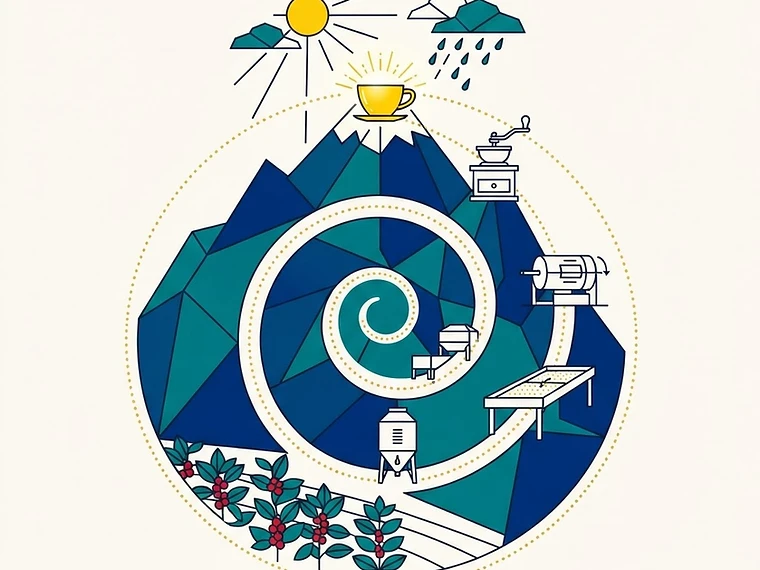
Sacred-geometry illustration of the farm-to-cup journey — a dotted spiral path from a coffee farm at the mountain's base, past fermentation and roasting emblems, up to a luminous cup at the summit.
Original artwork — sacred geometry. Never reused.

What happens between the farm and your cup?

Coffee seeds develop inside cherries, are harvested and processed, dried and often milled, then roasted, ground and brewed. These eighteen checkpoints are a useful map, not a universal checklist or a guaranteed route to better flavor. Some stages repeat or overlap; export and import apply only to internationally traded lots.

Read about processing methods or the people behind the work.

See how processing changes the route

All eighteen explanations remain visible. The selection marks where depulping and washing are typical or often skipped. Producers may use different techniques within any method.

01Growing
What happens
Growers tend coffee plants through pruning, soil, nutrition, water, shade, and pest management.
Who does this
The farmer and farm workers.
What can go wrong
Neglect, disease outbreaks, unbalanced shade.
How it affects flavor
Farm practices and growing conditions influence seed development but cannot guarantee any specific cup flavor.
02Flowering
What happens
Coffee flowers develop into fruit under favorable biological and environmental conditions; timing varies by origin.
Who does this
Growers manage conditions; the plant and sometimes pollinators drive flower and fruit development.
What can go wrong
Environmental stress can interfere with flowering and fruit set.
How it affects flavor
Flowering can affect the eventual crop size and timing; fewer flowers do not automatically improve flavor.
03Ripening
What happens
Coffee cherries mature over time, with the pace varying by variety, climate and farm conditions.
Who does this
Growers monitor maturity, while plant biology and growing conditions determine the timeline.
What can go wrong
Picking too early or too late.
How it affects flavor
Cherry maturity influences quality and uniformity, but is only one part of the sensory outcome.
04Harvesting
What happens
Cherries are selectively picked, strip-picked or mechanically harvested, depending on the production system.
Who does this
Pickers, growers and sometimes machine operators; labor arrangements vary widely.
What can go wrong
Stripping ripe and unripe together; green cherries taint the batch.
How it affects flavor
Harvest selectivity and sorting can influence lot consistency, alongside later processing and storage.
05Sorting
What happens
Cherries or parchment may be sorted before, during or after processing with flotation, hand sorting or machinery.
Who does this
Pickers and processing staff.
What can go wrong
Weak sorting can allow unwanted or damaged material to remain in a lot.
How it affects flavor
Sorting can reduce potential defects but cannot guarantee a specific cup profile.
06Depulping
What happens
Often in washed or honey workflows, skin and pulp are removed before drying; natural coffees generally dry as whole cherries.
Who does this
Mill and processing staff.
What can go wrong
Badly calibrated machines bruise or cut seeds.
How it affects flavor
Pulp removal changes the material around the seed and the subsequent processing route; it does not determine flavor alone.
07Fermentation
What happens
Microbial and enzymatic changes may occur in intact fruit, depulped coffee or controlled vessels, with methods varying widely.
Who does this
Producers, processing staff and microbes, whether naturally present or intentionally introduced.
What can go wrong
Inadequate control and sanitation can contribute off-flavors or spoilage; fermentation outcomes depend on conditions.
How it affects flavor
Microbial activity can influence flavor, but particular aromas and quality levels are never guaranteed.
08Washing
What happens
In some washed protocols, loosened mucilage is rinsed away; other workflows use mechanical demucilaging.
Who does this
Processing staff.
What can go wrong
Poor water management or unsanitary equipment can create quality and environmental risks.
How it affects flavor
Washing affects which fruit material remains; it does not guarantee a clear or high-quality cup.
09Drying
What happens
Whole cherries or parchment are dried on beds, patios or with mechanical equipment before stable storage.
Who does this
Drying teams — raking, turning, watching the weather.
What can go wrong
Uneven drying, re-wetting, contamination and excessive heat can compromise stability.
How it affects flavor
Moisture control and water activity influence storage safety and later cup quality; no specific note is guaranteed.
10Milling
What happens
Dried natural cherries or parchment are hulled as appropriate; green coffee may be size-, density- or color-sorted.
Who does this
Mill workers and graders.
What can go wrong
Cracked beans, mixed lots, lost traceability.
How it affects flavor
Milling can preserve quality and traceability or cause damage; a price outcome is not guaranteed.
11Storage
What happens
Green coffee is held in appropriate storage on farms, at mills or in warehouses until further handling.
Who does this
Warehouse and farm staff.
What can go wrong
Humidity, heat and time degrade green coffee.
How it affects flavor
Storage conditions and duration can affect aroma and cup quality; a crop label alone cannot prove freshness.
12Export
What happens
Internationally traded lots may be consolidated, documented and shipped; domestic coffees may skip this stage.
Who does this
Exporters.
What can go wrong
Moisture in transit, delays, heat in ports.
How it affects flavor
Transit conditions can preserve or reduce green-coffee quality; shipping is not a flavor-making process.
13Import
What happens
When imported, coffee clears border requirements and enters storage or onward transport.
Who does this
Importers.
What can go wrong
Poor handling repeats every export risk.
How it affects flavor
Careful import handling helps retain lot identity and quality; no import step is required for domestic sales.
14Green buying
What happens
Buyers and roasters may evaluate samples and select lots using cupping, records and contracts.
Who does this
Green buyers and roasters — the bridge of trust between farm and cafe.
What can go wrong
Incomplete sample evaluations or identity records can make purchasing decisions less informed.
How it affects flavor
Lot selection affects what is roasted and offered, but does not determine a community's preferences.
15Roasting
What happens
Roasters apply heat to green coffee, creating many aroma compounds and changing its physical properties.
Who does this
Roasters.
What can go wrong
Scorching, underdevelopment, baked roasts.
How it affects flavor
Roasting affects the final sensory result; lighter and darker are not universal quality rankings.
16Resting
What happens
Roasted beans release carbon dioxide during storage; appropriate resting time varies by roast and brewer.
Who does this
Roasters, packaging teams and brewers.
What can go wrong
Brewing too soon or after prolonged exposure may affect aroma and extraction depending on the coffee.
How it affects flavor
Resting can change extraction behavior, but no fixed number of days applies to every coffee or brew method.
17Grinding
What happens
Beans are ground fresh, to the size the brew needs.
Who does this
You or your barista.
What can go wrong
A mismatched grind or uneven particle distribution can complicate extraction.
How it affects flavor
Grind interacts with dose, water, geometry and brewing time to influence extraction.
18Brewing
What happens
Water extracts soluble substances from ground coffee through a chosen brewing method.
Who does this
You — the last link in the chain.
What can go wrong
Poor water suitability, inconsistent brewing parameters or uneven extraction can limit the result.
How it affects flavor
Brewing and personal taste shape the final cup, without overriding every earlier production decision.

Questions about the journey

Does every coffee go through all eighteen stages?

No. These are eighteen teaching checkpoints, not a mandatory sequence. Natural processing generally skips depulping and washing before drying, and locally consumed coffee may never be exported or imported.

How is natural coffee different from washed or honey coffee?

In natural processing, whole coffee cherries dry together. In many washed workflows, fruit is removed before drying and mucilage is removed or rinsed. Honey processing typically dries depulped seeds with some mucilage remaining. Practices and terminology vary.

Which single step makes coffee taste best?

There is no single stage. Plant material, cultivation, cherry condition, post-harvest work, storage, roasting, grinding and brewing can all affect the experience. A process label alone does not guarantee a tasting note or a quality score.

Sources and their limits

These references document general stages and techniques, not a universal eighteen-step standard, a guaranteed flavor, or any named producer's exact process.

Editorial source review: October 11, 2026. See our research and corrections policy.

The philosophy

Coffee is shaped by people and choices, from the farmer and processing team to the roaster and brewer. The number and order of steps vary. Documenting who did what, and what we still do not know, is why this site exists.