
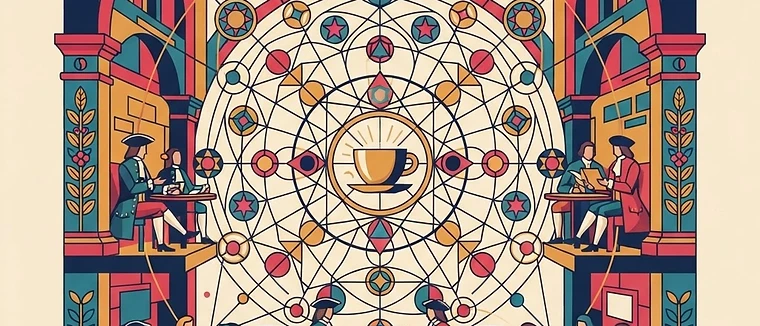
The Glass House of History: How Coffee Houses Created Modernity
Before they were home to Wi-Fi and power outlets, coffee houses served as the original internet, sparking revolutions and rewiring the human brain.
Coffee houses transformed from simple places to consume a stimulant into 'penny universities' where social classes mixed to share ideas. This exchange of information accelerated scientific discovery, artistic movements, and political reform that define our world today.
The Rise of the Penny University
In the mid-17th century, the coffee house emerged in London as a stark alternative to the alehouse. While beer was the staple beverage of the era, providing calories but often clouding the mind, coffee offered a sharp, clear-headed stimulation. For the price of a penny, anyone could enter these establishments, gain access to the latest news, and participate in heated debates.
These venues were dubbed 'penny universities' because they functioned as egalitarian spaces of learning. Unlike the strictly hierarchical guilds or aristocratic salons, the coffee house allowed a merchant to sit beside a philosopher or a poet. This mixing of social strata proved revolutionary, as it facilitated the rapid flow of information, gossip, and business intelligence across town.
The Architecture of Ideas
Coffee houses were not just businesses; they were specialized communication hubs. Lloyd's of London, the world-famous insurance market, began as a coffee house where maritime shipping news was exchanged. If a ship arrived in port, its status was posted on a board at the coffee house, creating a real-time data flow that became the backbone of international trade.
By focusing on information rather than intoxication, coffee houses helped shift the European intellectual culture from the tavern’s lethargy to the coffee house’s intensity. This fostered a climate where innovation was not just encouraged but expected. The shared focus on accuracy and discourse set the stage for what we now recognize as the Enlightenment.
A Catalyst for Change
The political influence of the coffee house was so potent that rulers frequently feared them as 'seminaries of sedition.' Because they gathered large groups of people in a centralized location to discuss the state of the world, they naturally became the birthplaces of political movements.
From the French Revolution to the shaping of the American colonies, coffee houses provided the physical space for disparate voices to organize. In these spaces, individuals realized that their grievances were shared, transforming private dissatisfaction into public policy.
Coffee Culture and Modernity
Modernity relies on the free exchange of ideas, and the evolution of the coffee house is arguably the greatest catalyst for that exchange in the last four centuries. The jump from the traditional, smoky coffee house to the high-tech cafes of today is massive, yet the core function remains the same: it is a third space between the home and the office where the mundane is discarded in favor of meaningful conversation.
As we look at today's specialty coffee landscape, we see a continued legacy of this history. We value the origin, the story, and the 'who' behind the brew, mirroring the way early patrons valued the specific news and intellectual insights delivered to them alongside their cup. Coffee remains, as it always has been, the fuel for the inquisitive mind.
- · The World of Caffeine: The Science and Culture of the World's Most Popular Drug
- · Uncommon Grounds: The History of Coffee and How It Transformed Our World (Mark Pendergrast)
- · British Museum archives on Coffee House culture
- · The London Coffee House History Project