Place · people
Follow coffee to its origin
Who grew it, and where?
Start with the growing landscape, move into origin guides, then inspect farm and producer records. Not every coffee names an individual farmer.
2 pages on this site carry this tag — reviews, profiles, answers and stories. Tags are derived from our documented data, never invented.
Bitta Farm is a significant coffee estate located in the Kaffa region of Ethiopia, the historical birthplace of coffee. It is recognized for its large-scale production of JARC-selected coffee varieties and its commitment to integrating traditional farming with modern, sustainable agricultural practices to ensure consistent quality and community support.
Research entry updated 2026-09-28 · not source-audited · 2 sources
Bitta Farm is situated in the Kaffa region of Ethiopia, a location widely regarded as the ancestral home of Arabica coffee. Spanning approximately 912 hectares, the farm serves as a critical site for preserving the region's ancient coffee heritage while simultaneously applying contemporary agricultural standards. By operating at this scale, the farm bridges the gap between historical coffee origins and the rigorous demands of the modern specialty coffee market.
The estate is owned and managed by Mullege, a long-established Ethiopian export company. This family-run business model is central to the farm's operations, as it allows for vertical integration and strict oversight of the coffee supply chain. By maintaining control from the initial cultivation and harvest stages through to processing and final export, the organization ensures a level of consistency that is often difficult to achieve in more fragmented production environments.
Bitta Farm is specifically noted for its cultivation of JARC (Jimma Agricultural Research Center) varieties, including selections such as 74110, 74112, 74140, and 8136. These varieties are highly valued in the specialty sector for their specific cup profiles and resilience. The farm typically employs washed processing methods, which are designed to highlight the inherent clarity, juiciness, and floral notes characteristic of high-altitude Ethiopian coffees.
Beyond its production output, Bitta Farm functions as a hub for local development. The management invests significantly in regional infrastructure, providing training and support to neighboring communities. This focus on social responsibility is considered a key component of the farm's operational philosophy, as it fosters a stable environment that supports both the livelihoods of local farmers and the long-term quality of the coffee produced.
For the roaster and the consumer, Bitta Farm represents a reliable source of traceable Ethiopian coffee. In an industry where traceability is increasingly vital for quality control and storytelling, the farm provides a clear link between the specific growing conditions—at altitudes ranging from 1900 to 2050 meters above sea level—and the final cup. This transparency allows for a more nuanced understanding of the coffee's origin, moving beyond generic regional labels to a specific, managed estate.
The flavor profile associated with Bitta Farm is often described as organized and clean, featuring a citrus-forward acidity, notes of dried fruits, and a spicy finish. By avoiding the inconsistencies sometimes found in wild-harvested or smallholder-aggregated lots, the farm offers a consistent experience that reflects the unique terroir of Kaffa. This balance of tradition and modern management positions Bitta Farm as a notable example of how large-scale estates can contribute to the specialty coffee landscape.
This topic connects to broader guides. Follow the sequence, or return to the complete TAG directory to explore other subjects.
Who grew it, and where?
Start with the growing landscape, move into origin guides, then inspect farm and producer records. Not every coffee names an individual farmer.
How does coffee shape people and markets?
Place farming, livelihoods, coffee history and cultural practice alongside the cup, with dates and citations evaluated separately.
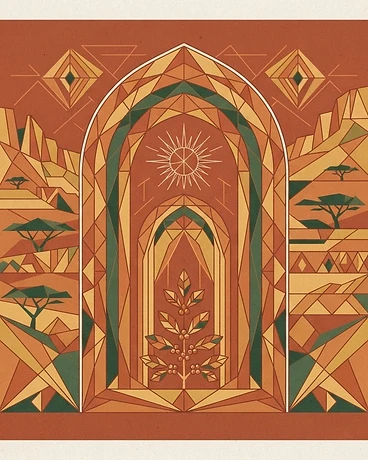 Editorial illustration
Learn something new, follow the people behind your cup, or explore by flavor and tags.
