Place · people
Follow coffee to its origin
Who grew it, and where?
Start with the growing landscape, move into origin guides, then inspect farm and producer records. Not every coffee names an individual farmer.
73 pages on this site carry this tag — reviews, profiles, answers and stories. Tags are derived from our documented data, never invented.
India is a significant global coffee producer, historically renowned for its shade-grown cultivation and the unique 'monsooned' processing method. While the country produces both Arabica and Robusta, it has established a distinct reputation as a high-quality source for Robusta and specialty-grade Arabica grown under diverse, spice-rich canopies.
Research entry updated 2026-10-06 · not source-audited · 8 sources
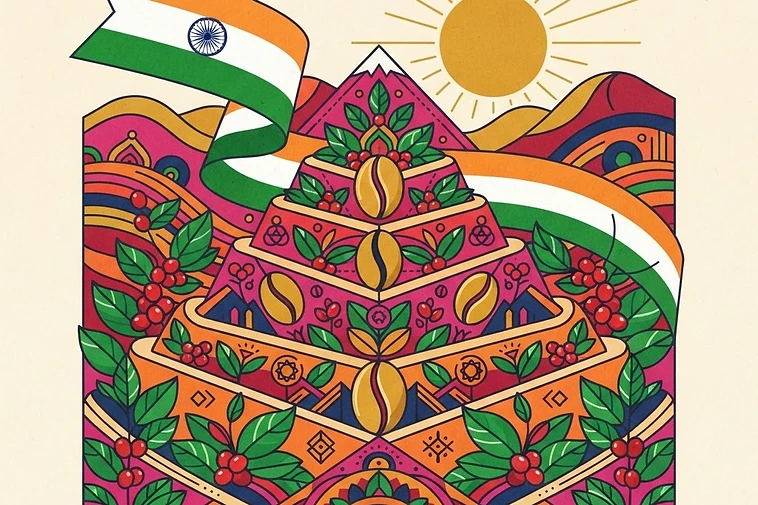
Coffee cultivation in India is deeply rooted in legend and geography, tracing its origins to the 17th century when a Sufi saint named Baba Budan reportedly smuggled seven coffee seeds from Yemen to the hills of Chikmagalur. This act established the foundation for what has become a vital agricultural sector, primarily concentrated in the southern states of Karnataka, Kerala, and Tamil Nadu. Today, India ranks among the world's top coffee producers, with a production landscape defined by smallholder farmers—who account for approximately 98% of the country's growers—and a commitment to shade-grown practices that integrate coffee with pepper, cardamom, and fruit trees.
The country's coffee geography is dominated by Karnataka, which produces roughly 70% of the national output, followed by Kerala and Tamil Nadu. While Karnataka is celebrated for both its Arabica and Robusta, Kerala’s Wayanad region is a stronghold for Robusta, and Tamil Nadu is recognized for high-altitude Arabica grown in the Nilgiris, Shevaroys, and Palani Hills. Beyond these traditional hubs, emerging regions such as the Araku Valley in Andhra Pradesh and Odisha, along with the 'Seven Sister States' of Northeast India, are increasingly contributing to the country's diverse coffee profile.
India’s terroir is uniquely shaped by its climate and the practice of intercropping. The shade-grown environment, necessitated by the monsoon season, protects the coffee cherries from direct sunlight and contributes to a distinct flavor profile. This environment, combined with the proximity to spice crops, is often cited as a factor in the mild, aromatic qualities found in many Indian coffees. The Central Coffee Research Institute (CCRI), established in 1925, remains a critical institution in this ecosystem, driving research into variety development and sustainability in partnership with global organizations like World Coffee Research.
Perhaps the most iconic expression of Indian coffee is 'Monsooned Malabar.' This process involves exposing sun-dried beans to the moisture-laden winds of the South West Monsoon between June and September. The resulting coffee is characterized by a mellow body, earthy notes, and a distinct chocolatey profile, setting it apart from standard washed or natural coffees. This method highlights the industry's ability to leverage its specific environmental conditions to create a globally recognized specialty product.
Despite its historical success, the Indian coffee industry faces ongoing challenges, including the prevalence of the white stem borer and economic pressures that have led many farmers to shift from Arabica to Robusta. While Robusta has historically been associated with commercial blends or South Indian filter coffee, there is a growing movement to recognize India as a producer of high-quality Robusta. This shift is part of a broader effort to move beyond colonial-era perceptions and elevate the status of Indian coffee within the global specialty market.
For the modern roaster and consumer, India represents a complex origin that defies simple categorization. It is a country where traditional practices, such as monsooning, coexist with modern breeding programs and a burgeoning specialty scene. As the industry continues to evolve, the focus remains on balancing the high yields of Robusta with the pursuit of specialty-grade Arabica, ensuring that the country's rich agricultural heritage remains relevant in an increasingly quality-focused global market.
This topic connects to broader guides. Follow the sequence, or return to the complete TAG directory to explore other subjects.
Who grew it, and where?
Start with the growing landscape, move into origin guides, then inspect farm and producer records. Not every coffee names an individual farmer.

 Editorial illustration
Learn something new, follow the people behind your cup, or explore by flavor and tags.
