Worth the Price?
Understand bag sizes, cost per brew and documented coffee differences before judging value.
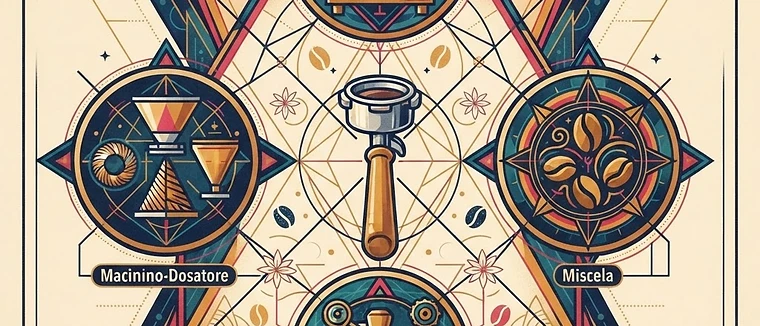
Before your favorite cafe was dialing in complex extractions, a strict Italian formula dictated the anatomy of every perfect shot of espresso.
The 4M's—Macinazione, Miscela, Macchina, and Mano—provide a foundational framework for understanding how grind, , machine, and barista skill interact. Mastering these four elements is the difference between a harsh, bitter shot and a syrupy, balanced espresso.
In the mid-20th century, as espresso culture solidified in post-war Italy, coffee professionals sought a way to standardize quality. They boiled down the complex variables of brewing into four pillars, all starting with the letter 'M' in Italian: Macinazione, Miscela, Macchina, and Mano. This framework serves as a checklist for any cafe looking to pull a consistent shot.
While modern brewing has introduced precision scales and digital profiling, the 4M's remain the bedrock of the craft. They remind us that espresso is not just a liquid; it is the result of a chain of decisions where each link determines the final cup quality.
Macinazione refers to the grind. Espresso relies on a very fine particle size to create the necessary resistance against pressurized water. If the grind is too coarse, water passes through too quickly, resulting in sour, watery coffee—a classic sign of under-extraction.
Conversely, if the grind is too fine, the water struggles to permeate the puck, leading to over-extraction and bitter, astringent flavors. The 'M' of Macinazione is all about finding that narrow window where the coffee particles are small enough to provide resistance but uniform enough to ensure even water flow.
Miscela is the . Historically, Italian espressos were composed of several coffee origins to achieve a balanced profile that offered body, acidity, and sweetness. In the classic model, this often meant balancing the heavy body of a low-grown bean with the vibrant acidity of a high-grown selection.
Today, the philosophy of Miscela has expanded. While some cafes prefer single-origin coffees to showcase specific , the concept of building a remains a powerful tool for consistency, ensuring that the espresso tastes harmonious even as individual coffee lots change throughout the year.
The Macchina is the heart of the operation. Without a machine capable of maintaining stable pressure and consistent water temperature, the other three M's are effectively neutralized. The transition from the lever machines of the early 1900s to modern thermal-block technology allowed for the ''—that golden foam—to become a signature of espresso.
The machine's role is to act as a heat exchanger and pressure generator. It must provide exactly 9 bars of pressure (the industry standard) at a stable temperature, typically between 195°F and 205°F. If the machine fluctuates, the extraction fluctuates, regardless of how good your beans are.
The final and perhaps most critical 'M' is Mano: the hand of the barista. This encompasses the skill of the operator in dosing, tamping, and monitoring the extraction. It is the human element that 'dials in' the coffee each morning, adjusting the grinder to compensate for humidity or the age of the beans.
Even with the best machinery and the finest beans, an unpracticed hand can ruin a shot. A good barista treats the 4M's as a living system, constantly observing the flow of the espresso and making minute adjustments to ensure that the final result is balanced, rich, and delicious.
No directly verifiable external source links are recorded for this story. Its research claims require further verification.
Explore documented coffee differences, then choose a brewing method. Related profiles are research connections, not proof that we tasted each coffee.
Understand bag sizes, cost per brew and documented coffee differences before judging value.
Follow documented origins to farms and the people behind the coffee. A profile is distinct from an original interview.
Separate tasting vocabulary from processing claims, then explore coffee profiles and brewing methods.
Learn something new, follow the people behind your cup, or explore by flavor and tags.