Worth the Price?
Understand bag sizes, cost per brew and documented coffee differences before judging value.
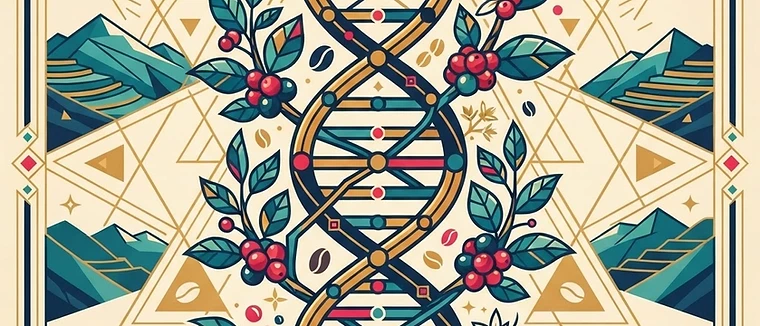
As climate change threatens traditional coffee varieties, scientists are mapping the genome of the coffee plant to identify traits for heat tolerance and disease resistance. This matters because it allows farmers to cultivate high-quality, delicious coffee that can actually survive in a warming world.
For centuries, coffee production relied on the serendipity of nature. Farmers planted what grew well, passed down by tradition. However, the coffee we drink today is largely susceptible to temperature shifts and pests, partly because much of the world's Arabica stock shares a remarkably narrow genetic pool. Scientists are now treating the coffee plant like a complex piece of code, looking for the specific genetic sequences—the 'lines of script'—that dictate a plant’s ability to thrive under stress.
By sequencing the genomes of heirloom varieties, researchers are discovering why some plants handle high heat better than others. It is not just about survival; it is about keeping the chemical compounds that give coffee its signature sweetness and acidity intact while the environment changes around it.
The Coffee Belt, that narrow strip of tropical land between the Tropics of Cancer and Capricorn, is narrowing as temperatures rise. Who decides which plants get to move to higher ground? Historically, it was the farmer, but the future is being decided in greenhouses and laboratories where researchers are testing hybrids that can grow in lower-, warmer environments without sacrificing quality.
The goal is 'climate-resilient quality.' We want the nuance of a high- bean with the robustness of a lower- plant. This is where breeding programs are looking at long-forgotten wild species from Ethiopia to inject genetic vigor back into the commercial coffee landscape.
In the past, breeding was a slow game of trial and error that spanned decades. Today, marker-assisted selection—using molecular tools to identify the traits in a seed long before it sprouts into a bush—has accelerated the timeline. Farmers no longer have to wait years to see if a new hybrid will be a success or a disappointment.
This precision allows for the development of varieties that are not just resistant to leaf rust—a fungus that can devastate coffee yields—but also capable of producing high-scoring, complex profiles. It is the intersection of high-tech biology and ancient agricultural wisdom.
While genetics provide the foundation, the way we process coffee is evolving in tandem. Fermentation science is now being used to unlock flavor profiles that were previously masked or underdeveloped in some of these newer, more resilient varieties. By applying controlled techniques, producers can coax extraordinary floral and fruity notes out of plants that are built to survive harsh conditions.
This synergy between a hardy plant and scientific processing means that the future of coffee isn't a tradeoff between sustainability and taste. It is an expansion of both.
No directly verifiable external source links are recorded for this story. Its research claims require further verification.
Explore documented coffee differences, then choose a brewing method. Related profiles are research connections, not proof that we tasted each coffee.
Understand bag sizes, cost per brew and documented coffee differences before judging value.
Follow documented origins to farms and the people behind the coffee. A profile is distinct from an original interview.
Separate tasting vocabulary from processing claims, then explore coffee profiles and brewing methods.
Learn something new, follow the people behind your cup, or explore by flavor and tags.